
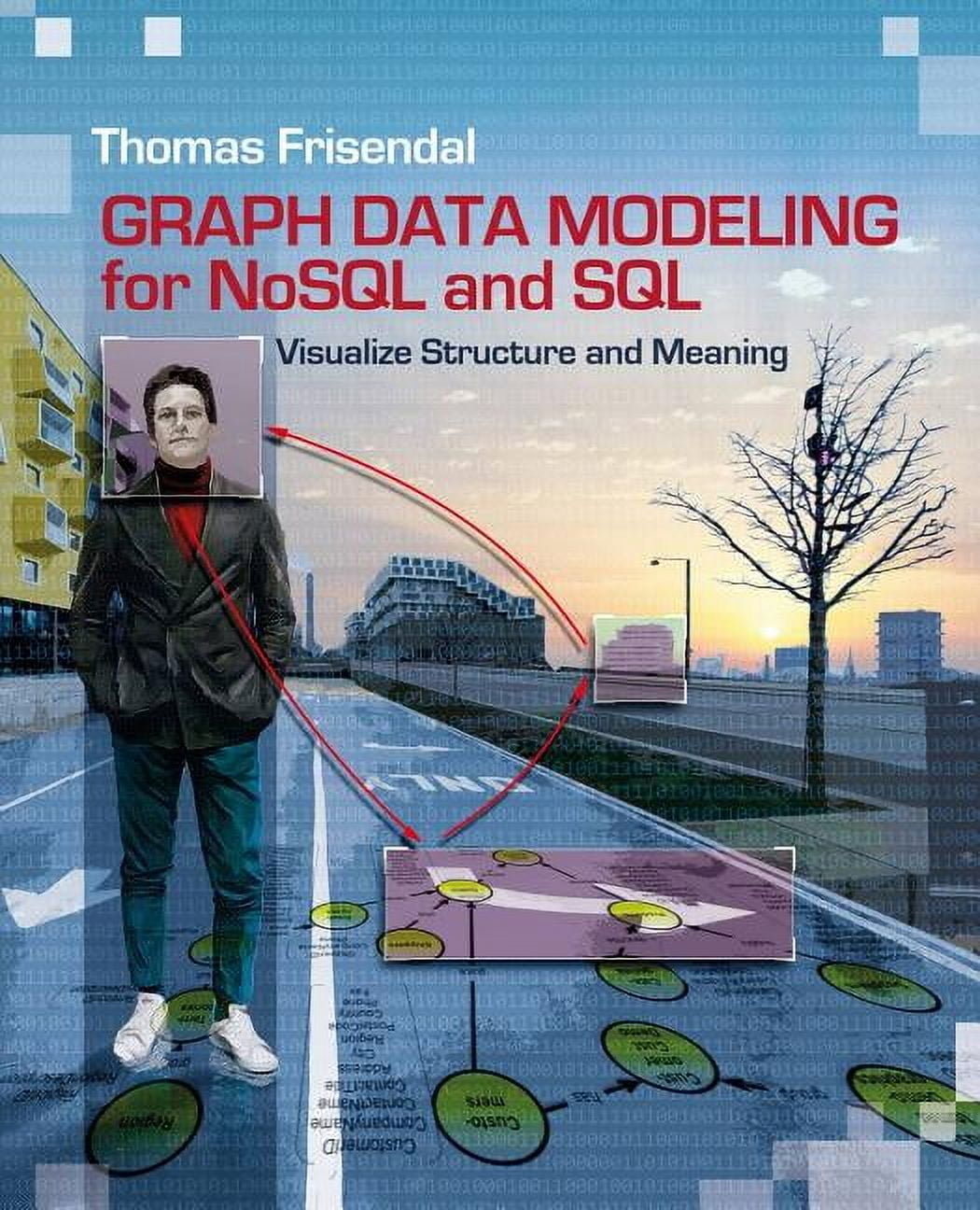
Graph Data Modeling for NoSQL and SQL: Visualize Structure and Meaning (Paperback)
Product details
| Management number | 238088468 | Release Date | 2026/07/11 | List Price | US$17.62 | Model Number | 238088468 | ||
|---|---|---|---|---|---|---|---|---|---|
| Category | |||||||||
<p>Master a graph data modeling technique superior to traditional data modeling for both relational and NoSQL databases (graph, document, key-value, and column), leveraging cognitive psychology to improve big data designs.</p><p> </p><p><strong>From Karen Lopez's Foreword: </strong></p><p><em>In this book, Thomas Frisendal raises important questions about the continued usefulness of traditional data modeling notations and approaches: </em></p> <ul> <li><em>Are Entity Relationship Diagrams (ERDs) relevant to analytical data requirements?</em></li> <li><em>Are ERDs relevant in the new world of Big Data?</em></li> <li><em>Are ERDs still the best way to work with business users to understand their needs?</em></li> <li><em>Are Logical and Physical Data Models too closely coupled?</em></li> <li><em>Are we correct in using the same notations for communicating with business users and developers?</em></li> <li><em>Should we refine our existing notations and tools to meet these new needs, or should we start again from a blank page?</em></li> <li><em>What new notations and approaches will we need?</em></li> <li><em>How will we use those to build enterprise database systems?</em></li> </ul> <p><em>Frisendal takes us through the history of data modeling, enterprise data models and traditional modeling methods. He points out, quite contentiously, where he feels we have gone wrong and in a few places where we got it right. He then maps out the psychology of meaning and context, while identifying important issues about where data modeling may or may not fit in business modeling. The main subject of this work is a proposal for a new exploration-driven modeling approach and new modeling notations for business concept models, business solutions models, and physical data models with examples on how to leverage those for implementing into any target database or datastore. These new notations are based on a property graph approach to modeling data.</em></p> <p> </p> <p><strong>From the author's introduction: </strong></p> <p>This book proposes a new approach to data modeling--one that "turns the inside out". For well over thirty years, relational modeling and normalization was the name of the game. One can ask that if normalization was the answer, what was the problem? There is something upside-down in that approach, as we will see in this book.</p> <p>Data analysis (modeling) is much like exploration. Almost literally. The data modeler wanders around searching for structure and content. It requires perception and cognitive skills, supported by intuition (a psychological phenomenon), that together determine how well the landscape of business semantics is mapped.</p> <p>Mapping is what we do; we explore the unknowns, draw the maps and post the "Here be Dragons" warnings. Of course there are technical skills involved, and surprisingly, the most important ones come from psychology and visualization (again perception and cognition) rather than pure mathematical ability.</p> <p>Two compelling events make a paradigm shift in data modeling possible, and also necessary: </p> <ol> <li>The advances in applied cognitive psychology address the needs for proper contextual framework and for better communication, also in data modeling, and</li> <li>The rapid intake of non-relational technologies (Big Data and NoSQL).</li> </ol>
Graph Data Modeling for NoSQL and SQL: Visualize Structure and Meaning (Paperback)| Manual & guide type | Instruction Manual |
|---|---|
| Book format | Paperback |
| Edition | First Edition |
| Pages | 216 |
| Language | English |
| Brand | Thomas Frisendal |
| Pub date | 2016-09-30 |
| Author | Thomas Frisendal |
| Subgenre | Computers |
| Genre | Computing & Internet |
| Bisac subject heading | Computers |
| Height | 9.2 in |
| Age group | Adult |
| Original languages | English |
Bestseller ranking
Double Wall Ovens


Customers who viewed this product also viewed
Pick Guards


Correction of product information
If you notice any omissions or errors in the product information on this page, please use the correction request form below.
Correction Request Form